Categories
Blog

Blog: Continuity

22/11/16 – Continuity Editing

Different styles of continuity editing can have contrasting effects on a film or television programme. It is important that the viewer can follow what is happening on-screen and doesn’t become disorientated by the confusing placement of actors or props, or cuts that subconsciously imply something has happened when in fact it hasn’t. All these factors, and more, are a part of continuity.

hiamxwytqgi5jcqnyzqwzxzryqvkxtw5_h264_3800_640x360_352124483894

Graphic continuity is when two shots are shown one after the other, with similarities in actions or layout. This type of continuity editing happens so often that it is expected and often goes unnoticed. The actor starts an action in one shot, such as opening a door, and the action is completed in the next shot – the camera cuts to the other side of the door and we see them walk through. This style of editing is only really noticed by a viewer if it is pulled off badly – for example, if the second shot jumps ahead too much, or the action is almost completed in the first shot and then only halfway complete in the second.

Rhythmic continuity is often coupled with the background music. The use of jump cuts and other montage features often shows a particularly slow or fast theme – for example, a car chase scene may make use of a series of fast cuts back and forth between the action, whereas a sad scene in a movie may use only one or two cuts in a whole scene.

180-degree-rule
The 180 degree rule

Spatial continuity incorporates a number of different rules. For example, when filming a conversation between two people using over-the-shoulder shots, each actor must stay on their respective side of the screen – this is known as the 180 degree rule. Another important rule is to keep the eye-line of the characters the same from shot to shot, especially in dialogue-heavy sections. Eye-lines on different levels would break the continuity. Another spatial continuity technique can give the impression that people are facing each other, even when they are in different locations or in different times. For example, a character looking into a mirror, and another character looking into their mirror from the other direction in another place.

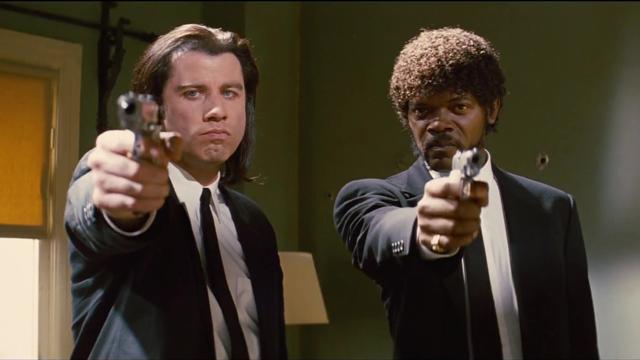
Temporal continuity is where the timeline, from the perspective of the viewer, is not in chronological order. For example, the on-screen characters don’t know what has happened, but the viewer has been shown the end result already. Visual examples of this style of editing include excerpts from Westworld, Memento and Pulp Fiction.

References and Further Reading:

Categories
Blog

Blog: Montage Editing

15/11/16 – Montage Editing

At the start of today’s lab, we were shown three short video clips. They each started with a different shot, for example a beautiful woman or a plate of food, followed by a head and shoulders clip of a man. In each clip, the mood of the man came across in a different way, even though it was exactly the same shot. This technique, first demonstrated by Lev Kuleshov, highlights the difference that simply changing the shots in a montage sequence can affect the mood in a dramatic way – this is called the Kuleshov Effect.

We then discussed a range of different montage editing techniques and I have researched some of them more thoroughly online. Herbert Zettl discusses several techniques in-depth in his book Sight, Sound, Motion. He explains how a montage is a juxtaposition of two or more seperate events that, when shown together and in a certain order, create a new and more intense meaning. He describes this new montage sequence as a ‘gestalt’, literally meaning ‘an organized whole that is perceived as more than the sum of its parts’.

Sequential (Analytical) Montage – in this editing tecnique, a series of events are quickly shown, remaining in chronological order. Often, the main event is not actually displayed to the viewer, it is however clearly implied to the viewer by the shots leading up to, and following, the event. Abenefit of this method is that a lot of information can be conveyed to the viewer in a very short space of time. A great example of this is the montage at the beginning of Up, showing Carl and Ellie’s life, right from first meeting to the death of Ellie, within 4 and a half minutes.

https://www.youtube.com/watch?v=1G371JiLJ7A

Sectional (Analytical) Montage – whereas the first method condenses a period of time into a few shots to form the montage, this technique focuses on a single moment in time and shows it from several different viewpoints. This allows the viewer to appreciate the complexity and impact of the on-screen events, or understand what different characters are thinking about the current situation. With this technique, the order of shots doesn’t matter too much. A certain character will ‘own’ the montage, however, if the sequence of shots starts with them. This could imply different points of view.

Comparison (Idea-Associative) Montage – both of the idea-associative techniques take two seemingly unrelated ideas and show them in the same montage in quick sucession. This creates a juxtaposition between the two different sequences that invokes a third, more powerful feeling, emotion or idea within the viewer. For the comparison idea-associative method, two similar shots are shown one after the other. One might show a dog rooting around in a bin for food, and the next show a homeless man also looking for food. This conjours emotions of sadness and empathy for the homeless man. A visual example of this technique is in the opening scene of Lucy, 2014 – a tense scene is intercut with clips from a cheetah hunt. The scene ends with the cheetah catching it’s prey, and a character getting shot.

https://www.youtube.com/watch?v=rBNnHlqO4cs

Collision (Idea-Associative) Montage – whereas the compairson shows visually or metaphorically similar shots in the montage, this technique shows shots with opposite meaning. One shot is the homeless man rummaging in the bin, and the next might be a well-fed man gorging himself on plentiful food. While the ‘comparison’ situation made the audience feel sorry for the homeless man, the ‘collision’ technique creates anger towards the well-fed man at the inequality of the situation.

References and Further Reading: